
Persian Rugs
Hand-knotted in Iran on a cotton foundation, usually with an asymmetric Persian knot that lets the weaver draw curves rather than steps.
How to tell
Turn it over. A Persian shows a dense, slightly irregular grid of knots and the pattern reads as clearly on the back as the front. Curved vines and rounded medallions are the giveaway — the asymmetric knot lets a weaver bend a line in a way a symmetric knot cannot.
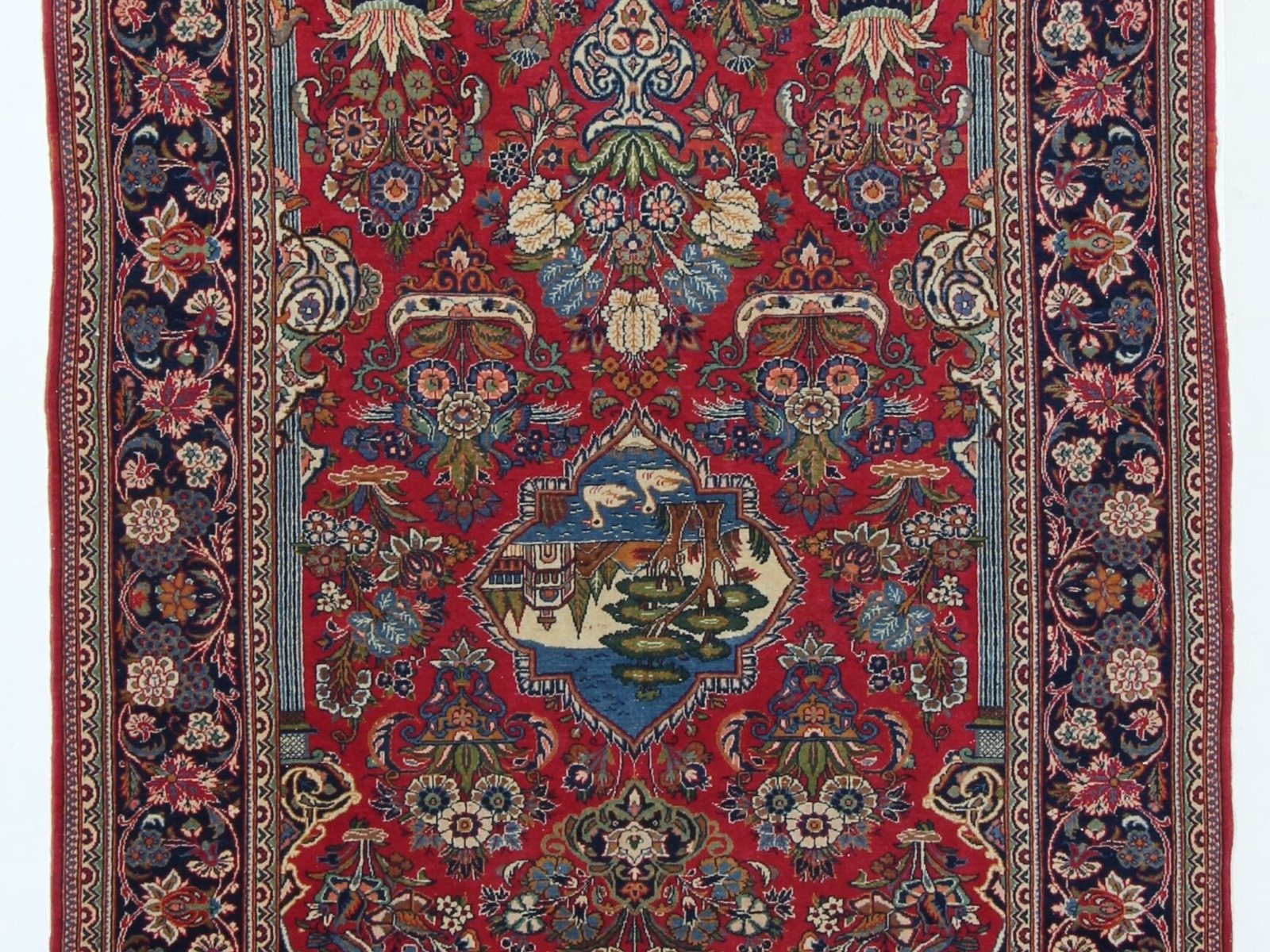
How we clean persian rugs
Older Persians frequently carry natural madder and indigo, and both can still move in water decades later. Every piece gets a dye-stability test on each colour before it is wet. Washing is by hand at low pressure with the pile, never against it, and drying is flat and slow so the cotton foundation does not shrink faster than the wool.
What goes wrong
Dry rot in the foundation from long damp storage, and sun fade along one edge where a rug was never turned. Both are common and neither is visible from the top until it is advanced.